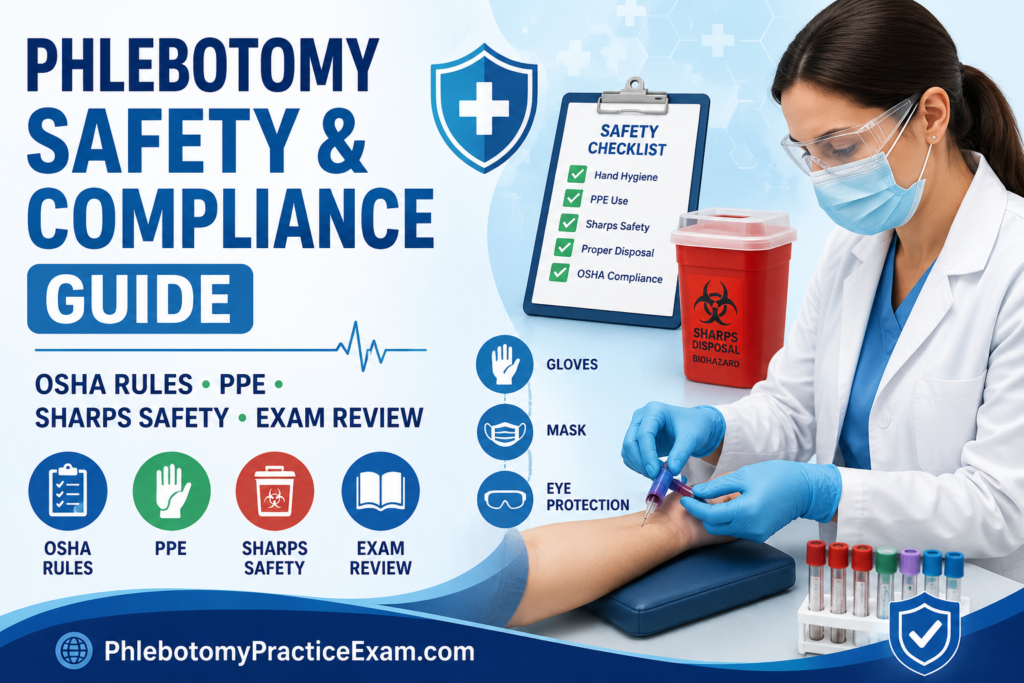
Patient preparation is the first critical control point in phlebotomy where accuracy, safety, and diagnostic validity are determined before blood is even collected. In real clinical environments, most laboratory errors do not happen in the analyzer—they begin during the pre-collection stage when patient verification, test requirements, or preparation steps are missed or incorrectly performed.
As part of a comprehensive Phlebotomy Study Guide, patient preparation serves as the foundation for safe specimen collection and accurate laboratory testing. Understanding this domain helps students connect pre-analytical procedures with the broader responsibilities of a phlebotomy technician.
Across certification exams such as National Healthcareer Association (CPT), American Society for Clinical Pathology (PBT), National Center for Competency Testing (NCPT), and American Medical Technologists (RPT), this domain is tested not as memorization—but as decision-making under clinical safety rules. Many patient preparation concepts also rely on a solid understanding of human anatomy, circulation, and vascular structures covered in our Anatomy and Physiology Study Guide.
To understand patient preparation correctly, you must think like a phlebotomist working in a real laboratory workflow:
Every step before needle insertion exists to prevent wrong-patient errors, invalid specimens, and patient harm.
1. Patient Identification — The Highest-Risk Control Point
Patient Identification Exceptions and Special Situations
In clinical practice, patient identification is not always straightforward. While the standard procedure requires two independent identifiers, phlebotomists must also know how to handle situations where the patient cannot actively participate in the identification process.
Unconscious or Unresponsive Patients
When a patient is unconscious, sedated, or otherwise unable to verify their identity, the phlebotomist must rely on approved identifiers such as the patient’s wristband and information contained in the medical record according to facility policy.
The inability of a patient to verbally confirm their identity does not eliminate the requirement for positive identification. Instead, additional verification procedures become even more important because the patient cannot help detect identification errors.
Pediatric Patients
Young children and infants may be unable to state their name or date of birth. In these situations, identification should be verified using the patient’s identification band and confirmed with a parent, guardian, or authorized caregiver when appropriate.
Certification exams frequently test the principle that the identification process must be adapted without reducing its accuracy.
Missing, Damaged, or Incorrect Wristbands
A missing or mismatched wristband represents a patient identification discrepancy.
If the information on the requisition does not match the wristband, the phlebotomist should not proceed with specimen collection until the discrepancy has been resolved according to facility policy.
Collecting a specimen before correcting the identification problem creates a significant risk of wrong-patient testing.
Common Certification Exam Scenario
A patient states their name correctly, but the date of birth on the requisition does not match the wristband.
What should the phlebotomist do?
The correct response is to stop the procedure and resolve the discrepancy before collection. Even a small identification mismatch must be investigated before a specimen is obtained.
Key Exam Takeaway
When patient identification is uncertain, the safest action is almost always to pause the collection process until the discrepancy is resolved. Certification exams consistently prioritize patient safety over speed, convenience, or assumptions.
2. Test Requisition Review — Preventing Wrong Test Collection
Before any contact with the patient, the phlebotomist must interpret the test order correctly.
This step is often underestimated, but it directly prevents pre-analytical rejection errors.
What must be verified?
A proper review includes:
- test type (CBC, glucose, lipid panel, blood culture, etc.)
- timing requirements (stat, timed, fasting)
- special handling instructions (light protection, chilled transport, etc.)
Why this matters clinically
Different tests require different conditions. For example:
- glucose testing is sensitive to recent food intake
- blood cultures require strict sterility
- coagulation tests require correct tube handling
If the wrong condition is used, the result becomes unreliable even if collection is perfect.
Exam focus point
Exams often test:
- “What should be checked before venipuncture?”
- “What causes rejection of a specimen before analysis?”
Correct answer logic:
test order verification + preparation requirements
3. Fasting Requirements — Controlling Biological Variability
Common Fasting Tests and Clinical Considerations
Understanding why fasting is required is more important than memorizing a specific number of hours. The goal of fasting is to reduce temporary biological changes that occur after eating and could affect laboratory interpretation.
Tests Commonly Associated With Fasting Requirements
Examples may include:
- Fasting blood glucose
- Lipid panels
- Certain metabolic studies
Because laboratory policies can vary, phlebotomists should always follow the specific instructions provided by the ordering provider or facility protocol.
How Food Can Affect Test Results
After a meal, nutrients absorbed from the digestive system enter the bloodstream and temporarily alter normal blood chemistry.
For example:
- Blood glucose levels typically increase after carbohydrate consumption.
- Triglyceride levels may rise following meals containing fat.
- Some metabolic markers fluctuate as the body processes nutrients.
These temporary changes may not reflect the patient’s baseline physiological state.
Verifying Fasting Status
Patient preparation includes more than simply asking, “Did you fast?”
A phlebotomist should clarify:
- When the patient last ate
- What was consumed
- Whether any beverages other than water were consumed
- Whether the patient understands the fasting instructions
This helps prevent misunderstandings that could affect specimen quality.
What If the Patient Did Not Fast?
A patient may arrive for testing and report eating shortly before the appointment.
The correct response depends on the test ordered and facility policy. In many situations, the phlebotomist should notify the appropriate healthcare professional or follow established procedures before proceeding.
The goal is not to make the decision independently but to ensure that the specimen collected will provide clinically useful information.
Common Certification Exam Scenario
A patient arrives for a fasting glucose test and states they drank a sweetened coffee two hours earlier.
What is the concern?
The concern is that fasting requirements may not have been met, which could affect the interpretation of glucose results. The situation should be addressed according to facility policy before collection.
Key Exam Takeaway
Certification exams often focus on the consequences of inadequate preparation rather than the fasting rule itself. Students should understand how food intake affects laboratory values and why verification of fasting status is an important part of patient preparation.
4. Patient Communication — Reducing Physiological and Psychological Error
Communication is not just courtesy—it directly affects physiological response.
When patients are anxious:
- heart rate increases
- vasoconstriction may occur
- fainting risk increases
What effective communication includes
A trained phlebotomist must:
- explain procedure clearly in simple language
- set expectations (brief pain, duration)
- reduce uncertainty
Why this improves sample quality
When a patient is calm:
- veins are easier to access
- movement decreases
- complications reduce
This directly improves first-attempt success rates.
5. Medical History & Pre-Collection Risk Assessment (Clinical Decision Layer)
Patient preparation is not complete after identification and test review. The next step is a clinical risk assessment, where the phlebotomist evaluates whether the procedure can be performed safely and under what modifications.
Unlike common assumptions, this step is not optional in real healthcare environments—it directly determines whether a standard venipuncture, modified technique, or postponement is required.
Why this step exists (clinical reasoning)
Blood collection is a controlled vascular injury. Even though it is routine, it can trigger physiological responses or complications in vulnerable patients.
Risk assessment prevents:
- syncope-related injury (fainting and falling)
- excessive bleeding in anticoagulated patients
- allergic reactions to materials (latex, antiseptics)
- procedure failure due to poor vein condition
5.1 Syncope history (vasovagal response risk)
One of the most important screening points is whether the patient has a history of fainting during blood draws.
What is happening physiologically?
During venipuncture:
- pain or anxiety can trigger vagal stimulation
- this leads to reduced heart rate and blood pressure
- cerebral perfusion temporarily decreases
Result:
vasovagal syncope (sudden fainting)
Why this matters in preparation
If a patient has a known history:
- seated collection becomes unsafe
- fall risk increases significantly
Clinical adjustment
For high-risk patients:
- supine positioning is required
- extended observation after collection may be needed
- rapid standing is strictly avoided
5.2 Anticoagulant and bleeding disorders
Patients on anticoagulants (e.g., warfarin or heparin therapy) or with clotting disorders require special consideration.
Why this matters
Even a standard venipuncture:
- creates a small puncture wound
- normally stops bleeding via clot formation
In anticoagulated patients:
- clot formation is delayed
- bleeding may persist longer than expected
Clinical adjustment
- apply pressure for longer duration after collection
- ensure bleeding has fully stopped before release
- avoid unnecessary multiple punctures
5.3 Allergies and material sensitivity
Latex allergy is a critical safety concern in clinical environments.
Why it matters
Exposure can trigger:
- skin reactions
- respiratory symptoms (in severe cases)
Clinical adjustment
- use non-latex gloves and equipment
- confirm allergy before selecting supplies
This is a patient safety compliance requirement, not a preference.
6. Patient Positioning — Biomechanics + Safety Control
Patient positioning is not just comfort—it is a physiological safety intervention that directly reduces complications.
6.1 Why positioning affects complications
During venipuncture, two risks are directly influenced by position:
1. Syncope risk
If a patient faints while standing or sitting without support:
- they may fall
- injury risk increases
2. Blood flow stability
Position affects:
- venous pressure
- vein accessibility
- stability of arm during puncture
6.2 Seated position (controlled standard use)
A seated position is acceptable only when:
- patient has no history of fainting
- patient is stable and responsive
- chair has arm support
Clinical requirement:
Arm must be supported and extended to prevent movement during puncture.
6.3 Supine position (high-safety configuration)
Supine positioning is used when risk is elevated.
Indications include:
- previous syncope during blood draw
- anxiety-induced fainting risk
- unstable patients (dizziness, weakness)
Why supine is safer:
- eliminates fall risk
- stabilizes blood pressure changes
- reduces sudden postural collapse
This is a preventive safety engineering control, not a comfort choice.
7. Infection Control During Patient Preparation (Barrier System Logic)
Infection control is not a checklist—it is a layered barrier system designed to prevent pathogen transmission at every patient interaction point.
7.1 Hand hygiene (critical control barrier)
Hand hygiene is the most important infection prevention step.
Why it is mandatory before patient contact
Hands are the primary vehicle for:
- bacterial transmission
- cross-contamination between patients
- surface-to-patient transfer
Even if gloves are used, hand hygiene is required because:
- gloves can have micro-tears
- contamination occurs during removal
- improper donning spreads pathogens
7.2 Gloves (single-patient barrier system)
Gloves are not reusable barriers—they are single-patient protective layers.
Clinical rule logic:
- one patient = one glove pair
- no reuse between tasks or patients
Why this matters:
Gloves:
- protect patient from provider contamination
- protect provider from blood exposure
- reduce direct contact transmission
7.3 Skin antisepsis (microbial load reduction)
Before puncture, the skin must be disinfected.
Why alcohol is used (70% standard practice)
- disrupts microbial cell membranes
- reduces surface bacteria significantly
- evaporates quickly, leaving minimal residue
Critical reasoning:
Skin is never sterile.
The goal is not sterilization—it is controlled microbial reduction at puncture site.
Infection prevention principles are heavily tested on certification exams. Reinforce these concepts with our Phlebotomy Safety and Compliance Quiz.
8. Special Patient Populations (Adaptive Clinical Decision-Making)
Patient preparation is not uniform. One of the most important professional skills in phlebotomy is recognizing that different patient groups require modified preparation strategies based on physiology, psychology, and safety risk.
This is heavily tested in certification exams because it reflects real-world clinical judgment rather than memorized steps.
8.1 Pediatric patients (behavioral + anatomical considerations)
Pediatric phlebotomy requires both technical adjustment and psychological management.
Clinical challenge:
Children have:
- smaller veins
- higher anxiety response
- limited understanding of procedure
Why this matters physiologically:
Stress in children can trigger:
- increased movement during puncture
- vasoconstriction (veins become harder to locate)
- higher pain perception response
Preparation strategy:
- use simple, non-threatening language
- allow caregiver presence when appropriate
- minimize waiting time to reduce anxiety escalation
- select equipment sized appropriately for smaller veins
Clinical reasoning:
The goal is not only successful puncture, but reducing sympathetic nervous system activation, which improves vein accessibility.
8.2 Geriatric patients (vascular and safety changes)
Older adults require modified preparation due to age-related physiological changes.
Common clinical characteristics:
- fragile veins
- reduced skin elasticity
- slower circulation
- increased dizziness risk
Why this matters:
Aging affects vascular integrity, meaning veins may:
- roll more easily during puncture
- collapse under excessive vacuum pressure
Preparation approach:
- ensure full patient stabilization before procedure
- avoid unnecessary repositioning once arm is placed
- monitor for dizziness before and after collection
Clinical reasoning:
The primary risk is not venipuncture failure—it is postural instability leading to falls or hematoma formation.
8.3 Anxious or needle-phobic patients
Anxiety is not just psychological—it has direct physiological effects on blood draw success.
What happens in the body:
Anxiety activates the sympathetic nervous system:
- increased heart rate
- muscle tension
- vasoconstriction
Impact on phlebotomy:
- veins become less visible
- patient may withdraw arm suddenly
- fainting risk increases
Effective preparation techniques:
- calm, step-by-step explanation
- allow brief stabilization time before puncture
- avoid rushed communication
- maintain consistent tone and posture
Clinical reasoning:
Reducing anxiety improves peripheral circulation and procedural stability, which directly increases first-attempt success rate.
Some patient populations and testing situations require modified collection techniques. Explore additional scenarios in our Special Collections Quiz.
9. Pre-Analytical Errors (Critical Exam Concept Layer)
A large proportion of laboratory errors occur before testing begins. This is known as the pre-analytical phase, and patient preparation is one of its most important components.
9.1 Why pre-analytical errors happen
Unlike analytical errors (machine-related), pre-analytical errors are caused by:
- human workflow failure
- communication gaps
- incorrect patient handling
- missing preparation steps
These errors are especially important because they often cannot be corrected after specimen collection.
Patient preparation is only one part of the pre-analytical phase. Proper labeling, transport, and handling are equally important for specimen integrity. Review these concepts in our Specimen Processing Quiz.
9.2 Major patient preparation-related errors
1. Misidentification errors
Cause:
- skipping two-identifier verification
- reliance on room/bed location
Consequence:
- specimen linked to wrong patient record
2. Improper fasting status
Cause:
- patient not informed correctly
- failure to verify preparation status
Consequence:
- inaccurate metabolic results (glucose/lipids affected)
3. Inadequate patient communication
Cause:
- no explanation or rushed instruction
Consequence:
- patient movement during collection
- increased anxiety and fainting risk
4. Poor positioning
Cause:
- failure to assess syncope risk
Consequence:
- falls or injury during or after collection
Clinical insight (important for exams)
Certification exams often test:
“What is the most likely cause of specimen rejection?”
The correct reasoning is usually:
- pre-analytical preparation failure, not machine error
10. Full Clinical Workflow Integration (How Phlebotomists Think in Practice)
To understand patient preparation at a professional level, you must view it as part of a continuous workflow rather than isolated steps.
Real-world sequence:
- Verify order
- Confirm patient identity
- Assess risk factors
- Communicate procedure
- Prepare physical environment
- Position patient safely
- Perform infection control
- Proceed to venipuncture
Once patient preparation is complete, the next step is performing venipuncture correctly. Test your knowledge with our Routine Blood Collection Quiz.
Key insight:
Each step acts as a safety checkpoint. If one step fails, downstream errors increase significantly.
Example:
- skipping risk assessment → patient faints
- skipping fasting check → invalid results
- skipping ID verification → wrong patient result
11. High-Yield Exam Concepts (Certification Focus)
Across National Healthcareer Association, American Society for Clinical Pathology, National Center for Competency Testing, and American Medical Technologists exams, patient preparation questions are usually scenario-based.
Key concepts repeatedly tested:
- Two identifiers rule (mandatory safety standard)
- Fasting requirements and effect on lab values
- Supine positioning for syncope prevention
- Infection control before contact
- Importance of requisition verification
- Communication as a clinical safety tool
Ready to apply what you’ve learned? Practice patient preparation concepts with our Phlebotomy Patient Preparation Quiz.
12. Practice Scenarios (Exam-Level Application)
Scenario 1
A patient reports dizziness during previous blood draws. What is the safest position?
Answer reasoning:
Supine positioning is required to prevent injury from vasovagal syncope.
Scenario 2
A lipid panel is ordered, but the patient confirms they ate breakfast. What should you do?
Answer reasoning:
Notify appropriate clinical staff because fasting status is not met; specimen validity is compromised.
Scenario 3
A patient refuses to confirm name and DOB but is known to staff. Can you proceed?
Answer reasoning:
No. Two identifiers are always required regardless of familiarity.
Scenario 4
Why is hand hygiene required even when gloves are worn?
Answer reasoning:
To prevent cross-contamination during glove application and removal, as gloves are not a sterile barrier.
13. Key Takeaways (Clinical Summary Logic)
- Patient preparation determines specimen validity before collection begins
- Identification errors are the highest-risk failure point
- Fasting status directly affects metabolic test accuracy
- Positioning reduces syncope-related injuries
- Infection control is a layered safety system, not a single action
- Most exam questions focus on decision-making, not memorization
Continue Your Phlebotomy Exam Preparation
After mastering patient preparation, continue building your certification knowledge with these resources: